
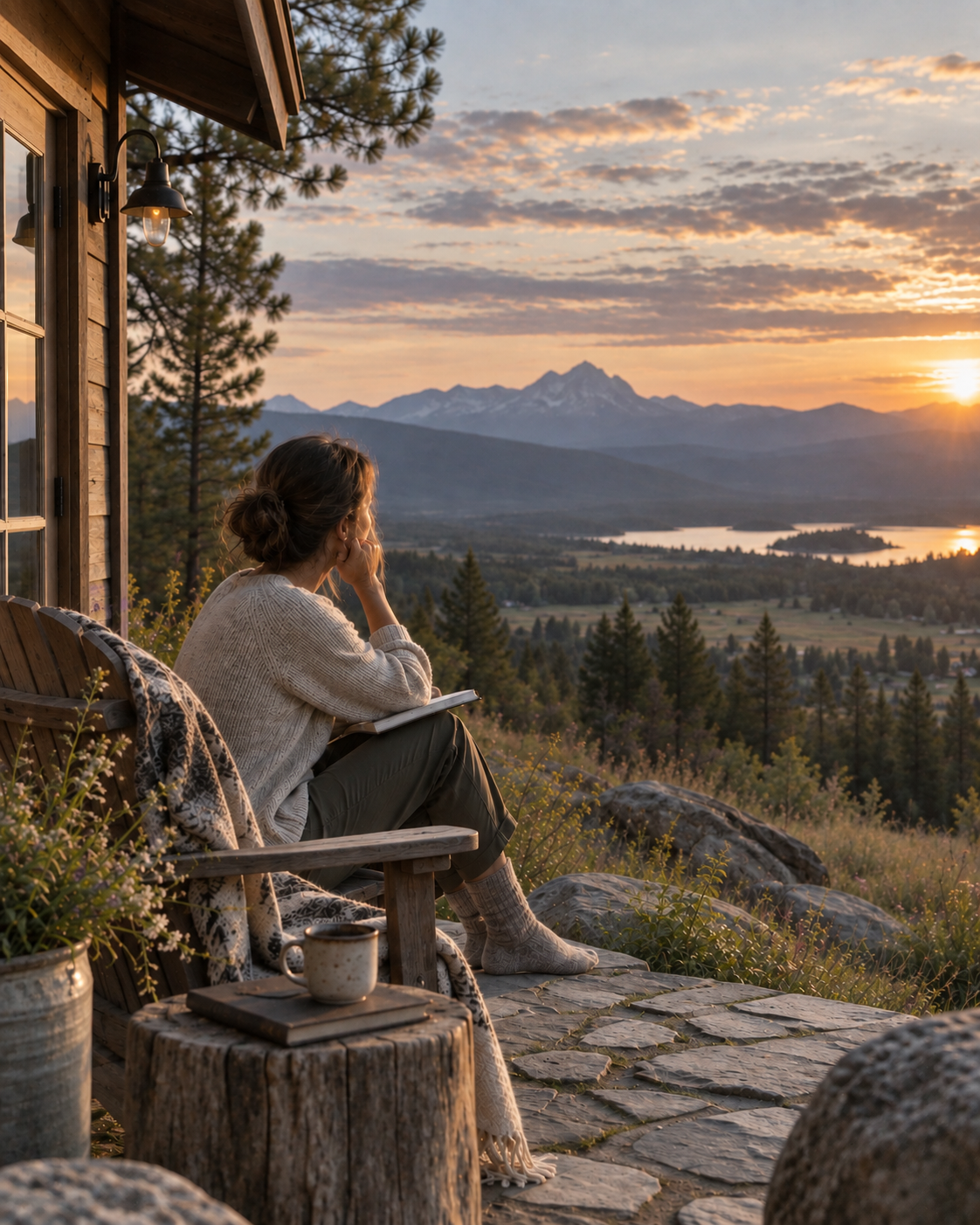
Personal Creative Retreat
Give your creativity room to move.
Come with a project, a question, a plan—or simply a need for enough space to discover what comes next.
A Personal Creative Retreat gives you a private environment organized around your creative life. You can use the time entirely in your own way, or I can help you assess where you are, structure the retreat, choose practices, and create a rhythm that supports what you want to accomplish.
Why Step Away?
Change the conditions around your creativity.
Daily life continually recruits attention. Work, relationships, responsibilities, screens, schedules, familiar environments, and unfinished tasks can leave very little space for a creative process to unfold on its own terms.
A retreat temporarily changes those conditions. There is less incoming demand, less switching, more space, and more freedom to follow what actually feels important.
Whether you feel blocked, bored, or simply aware that something new is trying to emerge, one useful place to begin is often surprisingly simple: let the nervous system settle. Sleep, food, walking, nature, quiet, movement, and time away from constant demand can restore the flexibility from which attention, curiosity, and creativity begin moving again.
Make It Your Own
Your retreat can be as open or structured as you want.
You do not need to follow a program. The ideas on this page are possibilities, not requirements. Bring whatever you are already planning—or ask for help designing a retreat around what your creative process needs now.
Bring your own plan.
Come to write, compose, paint, rehearse, think, read, design, finish something, begin something, rest, walk, meditate, or simply get far enough away from ordinary life to hear yourself again.
The retreat can simply provide the space, quiet, landscape, and uninterrupted time for whatever you already know you want to do.
You do not need to be coached or follow a prescribed process.
Let me help you structure it.
If you are not sure what would be most useful, I can help you look at your current creative process, identify where movement is needed, and suggest ways of organizing the retreat around that need.
We might design periods for focused work, rest, meditation, nature, incubation, experimentation, reflection, coaching, or integration—and adjust the rhythm as the retreat unfolds.
Structure is available when it helps. Freedom remains central.
If You Want Structure
One way a retreat can unfold.
If it is useful to have a process, we can build one around your project, question, block, transition, or larger creative direction. A structure might move through these stages without requiring that every retreat include all of them.
Arrive
Orient
Open
Make
Reflect
Return
Things You Might Do
Different activities change the creative process in different ways.
Choose what is useful. Ignore what is not. A retreat might contain only one or two of these elements, or move among several depending on what begins happening once you are here.
Rest & nervous system regulation
Sleep, eat well, walk, stretch, breathe, sit outside, reduce screens, and stop rushing. When the system is overloaded, restoring basic capacity can be more useful than trying to force inspiration.
Meditation & embodied awareness
Attend to breath, sensation, feeling, sound, imagery, and the wider perceptual field. This can help move the creative process away from constant conceptual control and back toward direct experience.
Walking & unstructured time
Take long walks without trying to solve anything. Sit with a view. Make tea. Let the mind wander. Leave enough space between periods of work for new associations to arise on their own.
Creative experimentation
Improvise, free-write, sketch, change constraints, combine fragments, work in an unfamiliar medium, or deliberately make versions that do not need to be good. Exploration increases the number of possibilities available.
Focused creative sessions
Protect uninterrupted periods for the thing you actually came to make. A retreat can be especially useful when meaningful work simply needs sustained time without fragmentation.
Journaling & inquiry
Ask what you are doing, why it matters, what feels alive, what feels dead, what you want more of, and what you may be ready to leave behind.
New input & perspective
Read, listen to music, explore another discipline, spend time in nature, engage philosophy or spirituality, or deliberately expose the project to a larger context. New input can reorganize familiar material.
Creative coaching
If you want another perspective, we can examine what is happening in your process, what seems to be missing, and what experiment or change in conditions might help restore movement.
What It Can Support
Come because something in your creative life needs space.
You do not need to arrive with a problem. A retreat can help restore something that has stalled, deepen something already working, or simply make room for a possibility you have not had enough time to explore.
Restore inspiration
Reintroduce novelty, feeling, curiosity, nature, experience, and spaciousness when the creative system has become depleted or repetitive.
Move through a block
Change the conditions surrounding a process that has become avoidant, pressured, exhausted, overcontrolled, or stuck.
Escape boredom
Step outside familiar inputs, habits, routines, and environments long enough for curiosity and novelty to re-enter the process.
Find authentic material
Move beneath habitual style and expected answers toward memory, feeling, lived experience, bodily information, curiosity, and what actually matters now.
Develop a project
Give meaningful material uninterrupted time and attention so it can become deeper, more coherent, and more fully formed.
Discover what comes next
Use the retreat when you are seeking but do not yet know the project, direction, question, or possibility you are looking for.
Who It’s For
Blocked, bored, seeking—or simply ready to work.
You do not have to be in crisis with your creativity. Sometimes the reason to retreat is simply that something deserves more attention than ordinary life allows.
Bringing It Home
Take whatever was useful back into ordinary life.
A retreat may produce work, insight, energy, rest, perspective, or simply a clearer relationship to what you want to do next.
Before leaving, it can be useful to notice what actually helped. Was it solitude? Nature? A slower nervous system? Long work periods? Less evaluation? New input? Walking? Conversation? A different daily rhythm?
Those observations can become practical information about how your creativity works—not only while you are away, but once you return home.
Personal Creative Retreat
Bring your own plan—or let me help you make one.
Tell me what you are working on, what you are looking for, or simply why you want to get away. You can use the retreat entirely on your own terms, or we can design a structure around what would be most useful for you.